
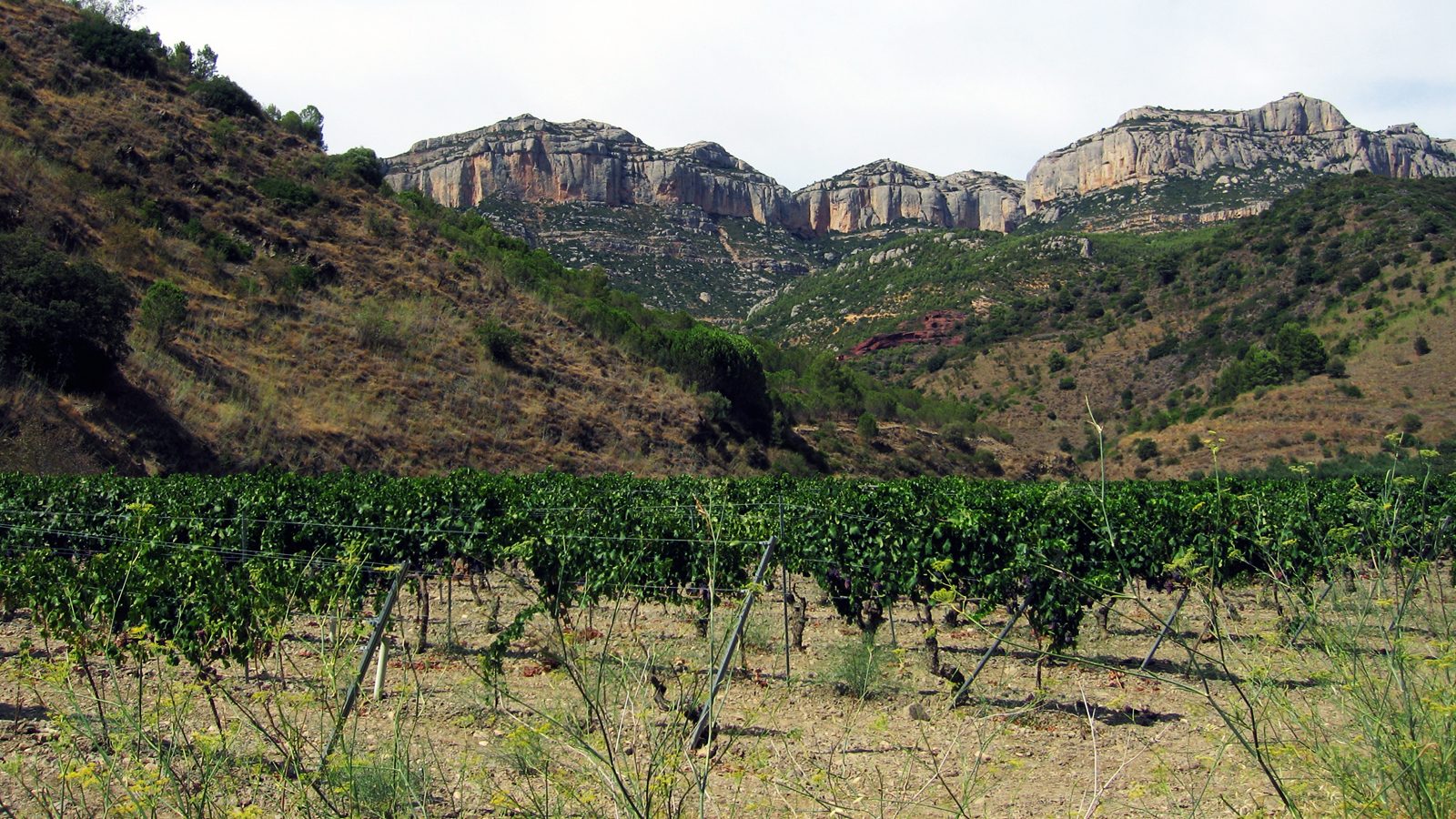
Priorat: How A Ruined Monastery Region Became One Of Spain's Most Expensive Wines
Same bulk-wine reputation as Languedoc-Roussillon, same rough era of reinvention — solved by doing almost the exact opposite.
Languedoc-Roussillon clawed its way out of a bulk-wine reputation by going bigger: modern equipment, scale, and technique applied across a huge stretch of southern France. Priorat, a couple of hundred miles away in northeastern Spain, climbed out of a near-identical hole by doing the exact opposite — going smaller, scarcer, and more expensive than almost anywhere else in the country.
Monks, then abandonment
Priorat takes its name from a Carthusian priory, whose monks planted vines on the region's brutally steep terraces centuries ago, working slate and quartz slopes that were never going to be easy land to farm. That difficulty eventually caught up with the region: by the mid-20th century, hand-farming those near-vertical terraces had become economically unviable compared to easier land elsewhere, and Priorat was largely abandoned, its vineyards left to fall apart along with much of its population.
What's actually in that soil
The ground itself is called llicorella — a dark, crumbly mix of slate and quartz that drains fast, reflects heat back up into the vines, and forces roots to dig deep for water, all of which concentrates flavour in whatever fruit survives. It's genuinely difficult, low-yielding soil, and that was precisely the problem when hand-farming steep terraces stopped being affordable. It only became an asset once a market existed that would pay a premium for scarcity rather than penalise it.
A handful of producers bet on less, not more
Starting in the 1980s, a small group of winemakers moved into the abandoned terraces and made a deliberate bet: rather than compete on volume, they'd lean entirely into what the region's old vines and punishing terrain already did naturally — tiny yields, intense concentration, and genuine scarcity. It worked. Priorat now holds DOCa status, Spain's highest classification, shared with only one other region in the entire country: Rioja.
Two regions, two exits from the same hole
Both regions needed reinvention to escape being written off. Languedoc-Roussillon did it by embracing scale and modern technology to make more, better wine, more reliably. Priorat did it by making less wine, on purpose, from land nobody else wanted, and charging accordingly. Same starting problem, same rough era of revival, and almost mirror-image solutions — proof there's more than one way out of a bad reputation.